
Key Takeaways
- Check the LED: If the little red light on the remote doesn't flash when you press a button, swap the CR2430 battery immediately.
- Power Cycle: Unplug the awning for 15 seconds and plug it back in before trying anything complicated.
- The "My" Button: Sometimes the remote isn't broken, the awning is just stuck in a preset. Press the center "My" button to stop it.
- The Reset Trick: The "2-10-2" power cut sequence is the gold standard for resetting a confused motor.
- Interference: Wireless weather sensors can override your remote commands if it's too windy.
The Short Answer: Try This First
If you're standing on your patio pointing that white wand at your awning and nothing is happening, here is the immediate fix 90% of the time: Change the battery. Even if the little red light flickers, it might not have enough juice to send the radio signal all the way to the motor.
If you put a new battery in and it's still dead, unplug the awning cord from the wall outlet, wait a full 15 seconds, and plug it back in. This reboots the motor's internal computer. If that doesn't work, grab a ladder, because we're gonna have to do some troubleshooting.
Is It Actually the Remote?
Before we tear apart the remote or start messing with expensive motors lets make sure we are fixing the right thing. I've gone over to help friends with this exact problem, only to find out the remote was fine but the outlet was dead.
Sunsetter awnings (and most motorized awnings, actually) use Somfy motors. These things are pretty bulletproof, but they are sensitive to power issues.
Check the GFCI Outlet
Most outdoor plugs are on a GFCI circuit (the ones with the "Test" and "Reset" buttons). If it rained recently, or if you had a power surge, that outlet might have popped. Plug a phone charger or a lamp into that same outdoor outlet. If the lamp doesn't turn on, your awning motor has no power. Reset the breaker or the button on the outlet, and your remote should start working again instantly.
Fixing the Battery Connection
Okay, so you know the power is on. Let's look at the remote again. Sunsetter usually ships with the Telis 1 or Telis 4 remote. They use a flat, coin-style battery. Specifically, it is usually a CR2430 battery. It is not the CR2032 that goes in your car keys, although they look almost identical.
I've made the mistake of jamming a CR2032 in there. It fits loosely, but it wont make good contact. Make sure you have the 2430.
Here is a weird trick that works: Sometimes the metal prongs inside the battery compartment get flattened out. If you replace the battery and it still doesn't work, take the battery out and gently pry those metal contacts up a little bit with a small screwdriver. This helps them grab the battery tighter. Its a small thing, but it happens a lot with older remotes.
The "Sleep Mode" Issue
A lot of people don't realize that the remote (or the motor) can basically go to sleep or get confused if you mash the buttons too many times. If you have been pressing "Up" and "Down" frantically, the motor might have locked itself out to prevent overheating.
The motors have a thermal sensor inside. according to the manufacturer specs, if the motor runs for more than 4 or 5 minutes continuously, it shuts down to cool off. It will act like the remote is broken, but really it's just protecting itself. If you've been playing with the awning a lot today, go inside, grab a drink, wait 20 minutes, and try again.
Reprogramming the Remote (The Standard Reset)
If the battery is good and the motor has power, the remote might have just lost its pairing. Think of it like Bluetooth headphones disconnecting from your phone. You need to introduce them to each other again.
You can find the official manual on the Sunsetter website, but honestly, their instructions can be a little dry. Here is how you actually do it in plain English:
- Cut the Power: Unplug the awning cord from the wall. You cannot do this just by turning off the remote. You have to kill power to the motor.
- Wait: Stand there for about 10 seconds.
- Power On: Plug the cord back in. The awning might jiggle or move a few inches. This is the motor saying "I'm awake."
- The Program Button: Flip your remote over. There is a tiny hole on the back, usually marked "Prog" or with a small circle. You will need a paperclip or a pen tip.
- The Handshake: Press and hold that button on the back. Watch the awning. It should "jog" (move slightly out and back in). Once it jogs, let go.
Try the up and down buttons now. If it moves, you're golden.
The "Nuclear Option": The 2-10-2 Reset
Okay, if the standard reset didn't work, we have to bring out the big guns. In the industry, guys call this the "2-10-2" method. It effectively wipes the memory of the motor and forces it to factory reset. It's a pain to do because you have to be precise with your timing, but it works when nothing else will.
You might need a helper for this if the plug is far away from where you are standing with the remote.
Step 1: The Power Dance
You need to cut power to the awning in a very specific pattern:
- Unplug the awning for 2 seconds.
- Plug it in for 10 seconds.
- Unplug it again for 2 seconds.
- Plug it in and leave it in.
If you did this right, the awning motor will move automatically. It might move for about 5 seconds or just jog. This means the motor has been wiped and is in "programming mode."
Step 2: Re-Pairing
Now, grab your remote immediately.
- Press and hold the Program button on the back of the remote until the awning jogs again.
- Now, check your directions. Press "Down." If the awning goes up, you need to reverse the motor (I'll explain that in a second). If it goes down, you are good.
My Remote Works but Directions are Backwards
This happens surprisingly often after a power outage or a reset. You press the "Down" arrow to extend the awning, but the fabric starts rolling up. Don't panic, you don't need to rewire anything. You just need to flip the software switch.
To fix this:
- Move the awning to a halfway point (press the middle "My" button to stop it).
- Press and hold the "My" button (the center one) and the "Up" button at the same time. Hold them until the awning jogs.
- Now test it. The directions should be swapped back to normal.
Is It The Weather Sensor?
I had a neighbor, let's call him Dave, who swore his remote was broken. He’d press the button to extend the awning, it would go out a foot, and then immediately roll itself back in. He bought a new remote and everything. It didn't fix it.
The problem wasn't the remote. It was the Wind Sensor.
Many Sunsetter models come with a little box attached to the front bar of the awning. This is a motion sensor. If it detects too much vibration (wind), it sends an emergency command to the motor to retract the awning so it doesn't get ripped off your house.
If the batteries in that wind sensor are dying, or if the sensor is malfunctioning, it will send "false alarms" to the motor. The motor prioritizes the wind sensor over your remote. Safety first, right?
The Fix: Look at the front bar of your awning. If you see a small rectangular box, slide it open and change the batteries (usually AAA). Or, if you suspect it's broken, you can temporarily disable it by taking the batteries out of the sensor entirely. If your remote starts working perfectly after you kill the sensor, you know that was the culprit.
Water Damage and Corrosion
We keep these remotes outside. I know we aren't supposed to. We are supposed to bring them inside or put them in that little plastic holder on the wall. But let's be real, it usually sits on the patio table.
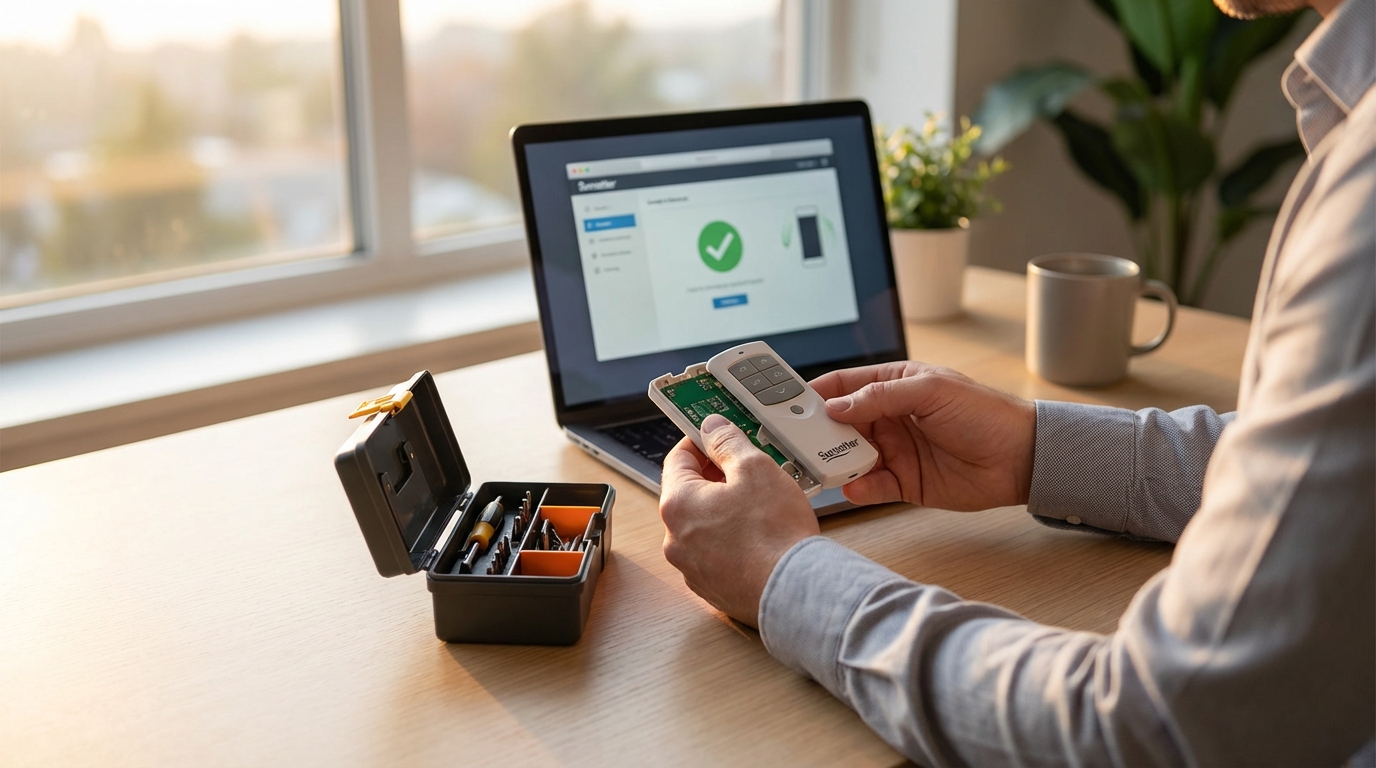
Even if you didn't drop it in the pool, humidity is a killer. Open up the battery compartment and look really closely at the green circuit board if you can see it. If you see any white or teal crusty stuff, that is corrosion.
You might be able to save it. Dip a Q-tip in some rubbing alcohol (isopropyl) and gently scrub that corrosion off. Let it dry completely. Pop a fresh battery in. I've saved a couple of TV remotes this way, and it works for awnings too. If the board looks black or burnt though, just go buy a new one.
When to Buy a New Remote
Sometimes, electronics just die. If you have changed the battery, done the 2-10-2 reset, checked the power, and cursed at it a few times and it still won't work, the remote transmitter might be fried.
You can buy replacement Telis remotes online. You don't necessarily have to buy the branded "Sunsetter" one, as long as it is a Somfy RTS remote. "RTS" is the radio frequency language they use. If you buy a generic one, just make sure it says RTS. However, for peace of mind, getting the official one from Sunsetter ensures you get the right support if it doesn't work.
Maintenance Tips to Avoid This Next Year
Since we're here, let's talk about keeping this thing running so you aren't reading this blog post again next summer.
Lubrication is key. The motor has to work harder if the arms are stiff. Every spring, spray some silicone lubricant (not WD-40! WD-40 attracts dirt) on the elbow joints of the awning arms. If the mechanical parts move smoothly, the motor draws less power and is less likely to overheat or get "confused."
Retract it when not in use. I know it looks nice, but leaving it out 24/7 exposes the fabric and the arms to the elements. The more you use the motor for what it was designed for (moving), the better it generally stays. Motors that sit frozen in one spot for 8 months sometimes seize up.
Advanced: Adjusting the Limits
Sometimes the remote works, but the awning stops in the wrong place. Maybe it doesn't close all the way, or it opens too far and the fabric sags. This is a "Limit Switch" issue.
On the new motors, this is all done via the remote. It's a bit of a complex button sequence involving holding the "My" and "Up" buttons simultaneously to enter "Limit Setting Mode."
If your remote is working but the limits are off, be very careful adjusting this. If you set the "in" limit too tight, the motor will keep pulling even after the box is closed, and you can strip the gears. My advice? If it closes 99% of the way, leave it alone. Its not worth the risk unless its really hanging open.
Manual Override
If you have a party starting in 30 minutes, the sun is blazing, and the remote is totally dead, look for the manual override loop.
Most motorized units have a small plastic loop hanging down from the motor side of the awning. Your kit should have come with a long white crank wand. Hook the wand into the loop and crank it. It takes forever (seriously, you have to turn it like 50 times to move it a foot), but it will get the shade out. Just remember, if you crank it manually, you might mess up the digital limits, so you'll likely have to do the "Reset" procedure we talked about earlier once you get the remote fixed.
Frequently Asked Questions
What kind of battery does the Sunsetter remote take?
Most standard Sunsetter remotes (the Telis models) take a CR2430 lithium battery. It looks like a quarter. Double-check your specific model, but that is the standard. Don't force a CR2032 in there.
Can I use a universal remote for my awning?
Generally, no. The Somfy RTS system uses a proprietary rolling code radio signal. You can't just point a cheap TV remote at it. However, if you have a smart home hub like a Bond Bridge or a specific Somfy interface, you can control it with your phone. But for a physical handheld remote, stick to the Somfy/Sunsetter replacements.
Why does my awning stop every few inches?
This is usually the "Job" mode or a weak signal. It means the motor isn't getting a continuous signal or it thinks it's hitting an obstacle. Try changing the remote battery first. If that fails, check the track/arms for debris that might be causing resistance.
Is there a fuse I can check?
There isn't a fuse inside the remote, but there might be a fuse or breaker for your outdoor outlet. Check your main house circuit breaker panel. Also, check the plug itself-some plugs have a tiny fuse inside the head, though that's rarer on outdoor appliances.
The light on the remote blinks but nothing happens. Why?
The LED takes very little power. The radio transmitter takes a lot more. A weak battery can easily light up the LED while failing to send the signal to the motor. Trust me, just change the battery first.