
Key Takeaways
- It’s called "Coffee Badging": This is the official term for showing up, swiping your ID, grabbing a coffee, and leaving to work from home. You aren't alone in doing this.
- Know your building's tech: If you have to swipe out as well as in, this strategy is much harder to pull off without getting caught.
- Visibility matters: You need to be seen by at least one person, but not the wrong person (like your boss, if they are strict).
- Digital presence is key: Your Slack or Teams status needs to be active on your phone while you are transitioning back home.
- Have a backup story: Always have a plausible reason ready for why you aren't at your desk if someone comes looking.
The "Pop-In" Strategy: How to Make Your Appearance Count
Here is the short answer: To successfully swipe in and leave to work remotely, you need to treat the office like a pit stop, not a destination. You go in, trigger the sensor that logs your attendance, make a brief physical appearance to establish you were there, and then retreat to your home office where you can actually get work done. It requires timing, a bit of acting, and understanding how your company tracks data.
Lets be real, the push for Return to Office (RTO) mandates feels a bit forced for a lot of us. You have been productive at home for years, and now you have to commute 45 minutes just to sit on Zoom calls you could have taken from your kitchen. It doesn't make sense. That is why "Coffee Badging" has become such a huge trend. According to a 2023 report by Owl Labs, nearly 58% of hybrid workers admit to going into the office just to show face and then leaving. You are definitely part of a movement.
But you have to be smart about it. You don't want to lose your job over a swipe. Here is how to handle the logistics, the social aspect, and the tech.
1. Assess the Security Hardware
Before you try this, look at the physical entry points of your office. This is the most important part.
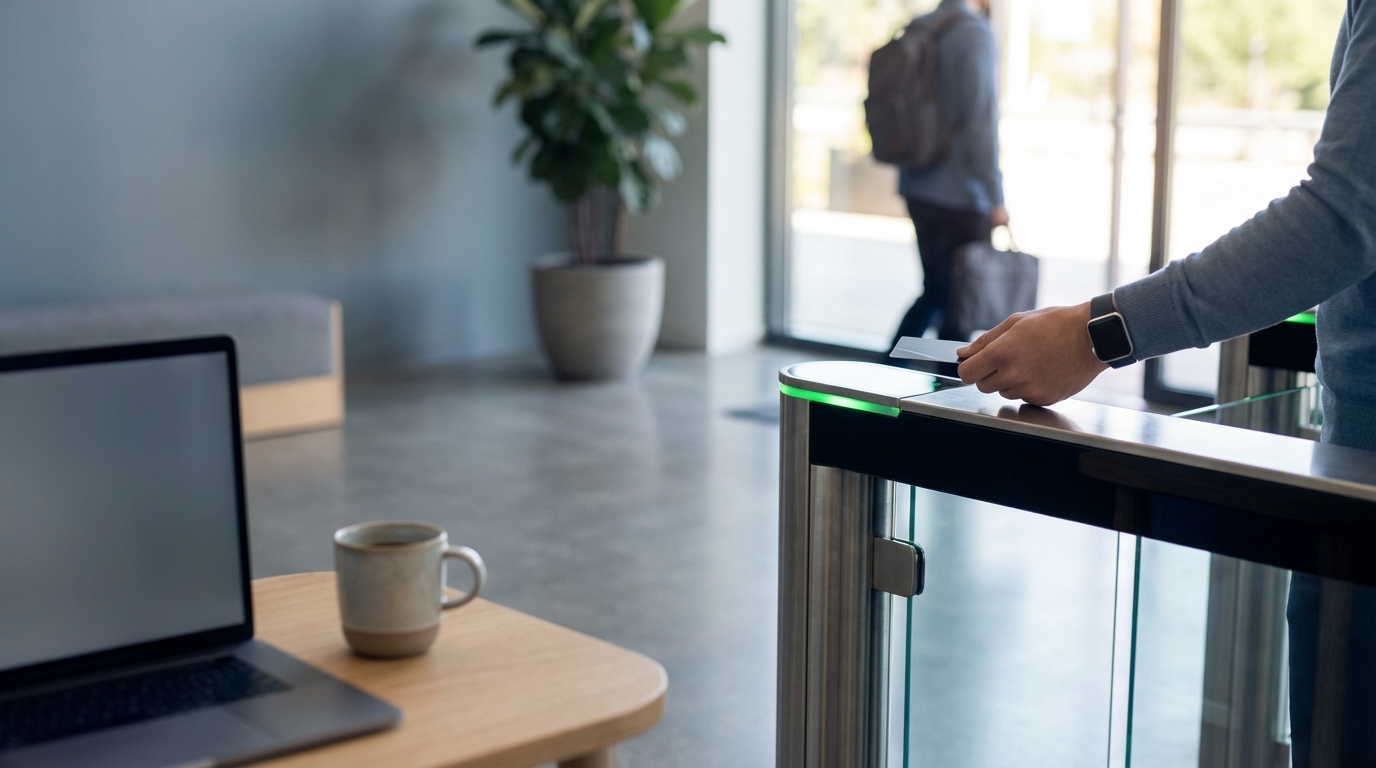
Most corporate offices use RFID or NFC badge readers. When you tap your card, a database logs a timestamp and your ID number. That data is what HR uses to generate those compliance reports.
The Entry: Almost every office tracks entry. That is the metric they care about. They want to know "Did Employee X come to the building today?"
The Exit: This is where it gets tricky. Does your office require you to badge out to leave the floor or the building? If you have turnstiles that require a swipe to exit, the system can easily calculate your "dwell time" (how long you stayed). If your dwell time is 14 minutes, you’re going to get flagged eventually. If your building has free-flowing exits (motion sensors that open the doors), the system likely has no idea when you left.
If you have to swipe out, this guide might not work for you unless you are okay with the system knowing you were only there for an hour.
2. The Timing Game
You have two main windows of opportunity here. You need to pick the one that fits your team's rhythm.
The Early Bird: You get there before everyone else. Swipe in at 7:30 AM or 8:00 AM. The office is empty. You walk to your desk, dock your laptop for five minutes (just in case IT tracks network connection locations), maybe move a chair or leave a post-it note. Then you leave. By the time your boss rolls in at 9:30, you are already back home and online. If they ask, you can say, "Yeah, I was in super early today to beat traffic."
The Mid-Day Swap: You work from home in the morning. You come in around 11:30 AM. You swipe in, say hi to a few people, go grab lunch with a colleague (this is great for "culture" points), and then head "out" after lunch. You just never come back to the desk. This works best if your boss is the type to be in meetings all afternoon.
3. Managing Your Digital Footprint
This is where amateurs get caught. Your physical body is leaving the building, but your digital avatar needs to look like it's working hard.
The biggest giveaway is the "gap." This is the time it takes you to travel from the office back to your house. If you are offline on Teams or Slack for 45 minutes at 10 AM, people get suspicious.
- The Mobile Hotspot: Keep Microsoft Teams or Slack open on your phone. Make sure your phone doesn't go to sleep and set your status to "Away." Actually, better yet, set it to "Busy."
- The "Commute" Excuse: If someone pings you while you are driving back, don't ignore it. Use voice-to-text to reply: "In a review right now, will call you in 20." This buys you time to get home.
- VPN Logs: Wikipedia explains that VPNs track IP addresses. If your company has a very strict IT security team, they can technically see that you logged in from the office IP address at 9:00 AM and then logged in from your home IP address at 10:00 AM. Most companies do not look at this data for attendance unless they are already looking for a reason to fire you. But its something to keep in mind.
4. The "Prop" Strategy
This is old school, but it works. If you have a dedicated desk, you need to make it look lived-in.
If you have a clean desk policy, this is harder. But if you don't, leave a chaotic jacket on the back of your chair. Not your nice winter coat that you need to go outside, but an old hoodie or blazer. Leave it there permanently. When people walk by and see the jacket, their brain subconsciously assumes "Oh, they must be in the bathroom or a meeting."
Do not leave your laptop. That is dangerous and you need it to work. But leaving a notebook open to a page with scribbles on it? That’s gold. It implies immediate return.
5. Social Engineering (The Art of the Chat)
You can't be a ghost. If you swipe in and nobody sees you, did you really go in? Well, the computer says yes, but human perception matters more for promotions and not getting on a performance improvement plan.
You need to be seen by a "Town Crier." Every office has one. The person who talks to everyone. Go to the break room, get a coffee, and bump into that person. Have a 5-minute chat about the weekend.
Once that interaction is done, you have a witness. You can leave. If your boss asks later, "Was Dave in today?" the Town Crier will say, "Yeah! I saw him in the kitchen this morning, we were talking about that new show on HBO."
That witness testimony is stronger than badge data in your manager's mind.
6. The "Soft" Exit
Never say goodbye. When you are ready to leave the office to head back to your comfortable home setup, do not wave to people. Do not say "See you tomorrow."
Just walk out.
Walk with purpose, like you are heading to a client meeting, or you need to take a private call in your car, or you are running an errand. If you look like you know where you are going, nobody questions you. If you look guilty or sneaky, that's when eyes follow you.
If you have a backpack, try to leave it in the car if you can. Walking out with a full bag looks like you are clocking out. Walking out with just your phone and keys looks like you are going to grab a sandwich.
Why Are We Even Doing This?
It feels a little silly, right? Acting like spies just to do our jobs. But the reality of the modern workplace is messy. Companies are paying for expensive real estate leases and they need to justify the cost to their shareholders. If the building is empty, they look like they are wasting money.
So, they track swipes. It's a metric of "utilization," not productivity.
You aren't necessarily a bad employee for doing this. In fact, many people find they get more work done at home because there are fewer distractions. You are just playing the game to keep HR happy while maintaining the work environment that helps you perform best.
What If You Get Caught?
Okay, let's talk about the worst-case scenario. Your boss calls you out. "Hey, I saw you badged in at 9 AM but you weren't at your desk at 11 AM. Where were you?"
Do not lie. Lies are what get people fired. But you can spin the truth.
The Spin: "Oh yeah, I came in this morning to sync up with the team, but the office was actually really loud/distracting/cold today, so I headed back to my home office to do some deep focus work on that Q3 report. I just work faster there."
This pivots the conversation from "truancy" to "productivity." You are prioritizing the work output. Most reasonable managers will accept this, especially if your work is good. If your performance is bad and you are badge-skipping, that is when you are in trouble.
Advanced Tactics: The "Lunch" Buffer
If you want to be safer, stay until lunch. 12:00 PM or 1:00 PM is a natural transition point.
If you leave at 1 PM, you have technically been there for "half a day." In many corporate policies, a half day counts as a day of attendance. Plus, traffic is usually better at 1 PM than at 5 PM.
Use the morning for face-to-face meetings. Schedule them all back-to-back. Then, tell your team, "I'm going to finish the rest of the day from home to clear my inbox." This is a very common hybrid work pattern and is usually less frowned upon than the "swipe and run."
Is It Worth It?
You have to do the math. If your commute is 15 minutes, absolutely. It's an easy win.
If your commute is an hour each way, spending two hours in the car just to spend 30 minutes in the office is a recipe for burnout. In that case, you might be better off negotiating a formal arrangement with your boss or just biting the bullet and staying for six hours.
Also, look at your company culture. If you work for a finance firm or a defense contractor with strict security, don't mess around with this. They watch cameras. If you work for a tech company or a creative agency, they probably don't care as long as the work gets delivered.
A Note on "Quiet Quitting"
Some people confuse this with "quiet quitting," but I think it's different. Quiet quitting is about doing the bare minimum. Coffee Badging is about fighting for flexibility. You are still willing to work hard; you just want to do it in a place where the coffee is better and you can wear sweatpants.
Just remember: The goal is to keep your job, not lose it. Be smart, be observant, and don't get greedy. If you swipe and leave five days a week, someone will notice. If you do it once or twice a week on the days you really need a break, you’ll likely fly under the radar.
Frequently Asked Questions
Q: Can HR track exactly where I am in the building?
A: Usually, no. Unless you have to swipe to get into specific rooms or floors, or if you are logging into different WiFi access points that are being actively monitored (which is rare for general attendance), they just know you entered the front door.
Q: Is this grounds for termination?
A: Technically, yes. It can be considered "time theft" or falsifying records depending on the wording of your employee handbook. However, usually, you will get a warning first unless you have other performance issues.
Q: What if my boss asks for a face-to-face meeting while I'm supposedly there?
A: This is the biggest risk. You need a "Go Bag" excuse. "I stepped out to grab lunch," or "I had a personal errand nearby." If you are actually 40 minutes away at home, say, "I'm not in the building right now, can we do this on Teams?" Honesty in the moment is better than getting caught in a lie about being in the bathroom for an hour.
Q: Does this work for hourly employees?
A: No. Do not do this if you are paid hourly. That is illegal wage theft if you are claiming hours you aren't working (or if the commute time counts differently). This guide is strictly for salaried, exempt employees whose pay is based on output, not minutes on the clock.
Q: Will badge data affect my promotion?
A: It might. Many companies use badge data as a tie-breaker. If two people are up for a promotion and one is there 5 days a week and the other is flagged for low attendance, the "visible" person often gets the edge. It's unfair, but it's human psychology.