
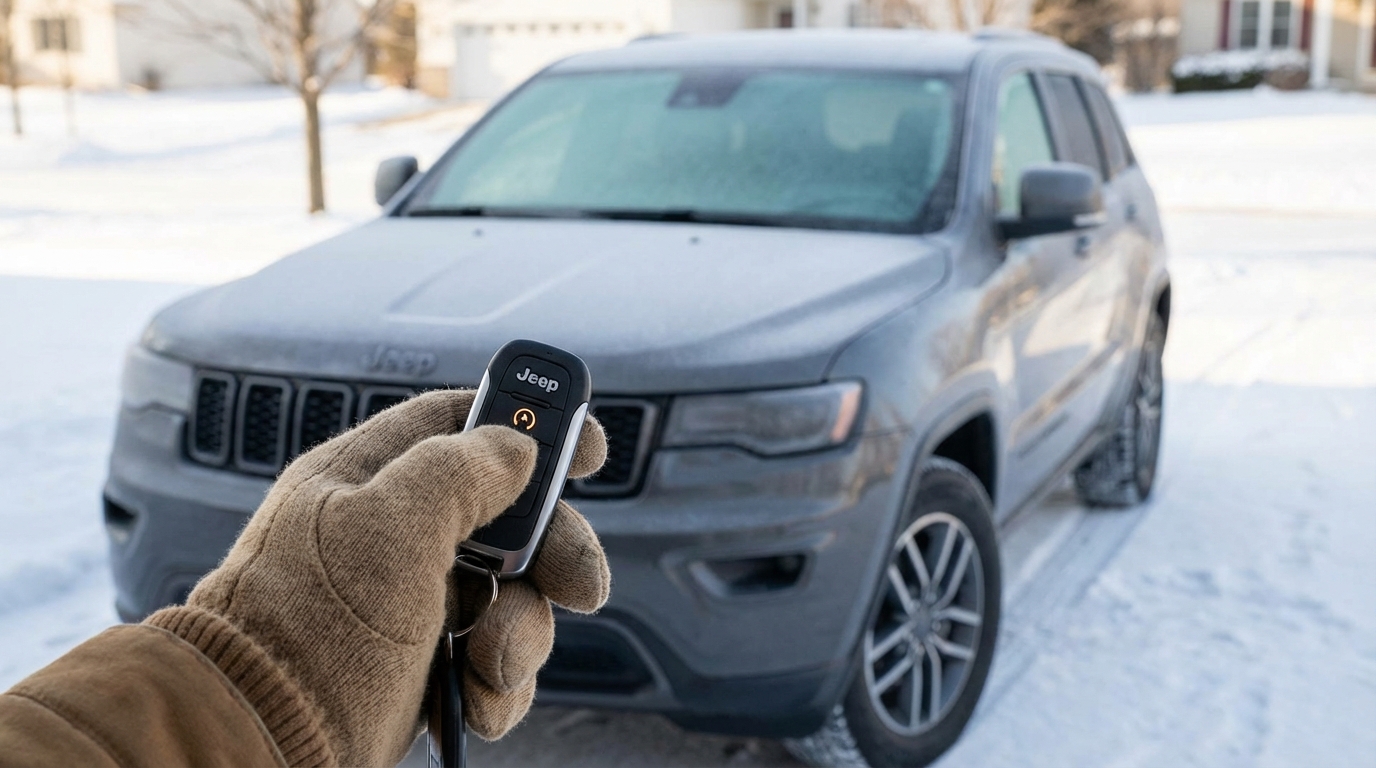
Key Takeaways: Quick Fixes
- Check Your Battery Voltage: This is the #1 cause. If your battery is even slightly weak (below 12.0V or 12.2V resting), the Jeep computer (PCM) will disable remote start to save energy for a manual crank.
- Look for the Check Engine Light (CEL): Any active warning light, even a minor EVAP leak, will automatically disable the remote start system for safety.
- The Hood Latch Sensor: In cold weather, the switch inside the hood latch often freezes or gets dirty, telling the computer the hood is "open."
- Low Fuel Level: If your gas light is on (usually below 1/8th of a tank), remote start is disabled to prevent running the tank dry.
- Door Ajar Sensors: Ice can prevent doors from closing fully, triggering a "door ajar" sensor which stops the start sequence.
Direct Answer: Why Your Jeep Won't Remote Start in the Cold
If your Jeep remote start isn't working this morning and it's freezing outside, it is almost certainly your battery voltage or a "Check Engine" light.
Here is the deal. Modern Jeeps (Wranglers, Grand Cherokees, Renegades, etc.) are incredibly sensitive to voltage drops. When the temperature drops, the chemical reaction inside your car battery slows down. According to most battery manufacturers, a lead-acid battery loses about 33% of its power when the temp hits freezing (32°F) and over 50% when it drops below zero.
Your Jeep’s computer runs a system check before it allows the remote start to engage. If it sees the voltage is even a tiny bit low-enough to still crank the engine with the key but lower than the "ideal" threshold-it aborts the remote start. It does this to protect you. It's saving that last bit of juice to make sure you can start the car manually when you get in.
So, if you press the button x2, hear the horn honk, but the engine doesn't fire up (or it starts and immediately shuts off), start by checking your dashboard for a Check Engine Light or check your battery voltage on the EVIC display.
The Deep Dive: Why Cold Weather Hates Your Remote Start
Alright, so we know the short answer. But if you want to actually fix this permanently or stop it from happening next time the temp drops, we need to dig a little deeper into how the system works. It can be super frustrating when you just want a warm car and the tech fails you.
1. The Battery Voltage Threshold
This is the thing most people miss. They say, "But my Jeep starts fine when I push the button inside!"
That doesn't matter. The parameters for Remote Start are much stricter than a manual push-to-start. The Jeep uses an Intelligent Battery Sensor (IBS) usually located on the negative terminal. This sensor is constantly reading the state of charge.
If the battery is old (3+ years) or it's just really cold, the resting voltage might dip to 11.9V or 12.0V. For a manual start, that's fine. For remote start, the computer says "Nope." It disables high-drain accessories and convenience features (like heated seats and remote start) to prioritize the engine crank.
The Fix: Check the voltage on your dashboard menu (EVIC). If it's reading low while the car is off (ignition in 'Run' but engine off), you probably need a new battery. If the battery is new, get a trickle charger and top it off overnight.
2. The "Check Engine" Light (CEL) Safety Protocol
You might not even notice you have a Check Engine Light on until you look closely. If that little orange engine icon is illuminated on your dash, remote start is hard-coded to fail. This is a safety feature programmed by Jeep.
The logic is simple: If the engine has a problem, the car doesn't want to run unattended. It wants a human in the driver's seat monitoring the gauges.
Why cold weather triggers this: Cold weather can cause materials to shrink. A common issue is the EVAP system (emissions). A seal might shrink just enough to cause a tiny vacuum leak, triggering a code. Or, sensors just act wonky in extreme cold. Once that code is thrown, remote start is dead until you clear it.
The Fix: You need an OBDII scanner. You can buy cheap ones on Amazon for like $20. Plug it in, see what the code is. If it's something minor, you can clear the code and remote start should work again immediately. Just make sure you actually fix the problem eventually.
3. The Frozen Hood Latch Switch (The "Jeep Special")
If you drive a Wrangler (JK or JL) or a Cherokee, this is a classic issue. There is a tiny micro-switch located inside the engine hood latch. Its job is to tell the car if the hood is open.
If the car thinks the hood is open, it disables remote start so that the engine doesn't turn on while a mechanic has their hands inside the belts. Makes sense, right?
The problem is that in the winter, road salt, grime, and ice get up into the grille area. That switch gets gunked up or freezes in the "Open" position. Even if your hood is latched tight, the sensor thinks it's open.
The Symptoms: usually, you press the fob, the horn honks once (or not at all), and the lights flash, but nothing happens. If you look at your dash display, it might explicitly say "Remote Start Aborted - Hood Ajar".
The Fix: Locate the latch under the hood. Spray it generously with WD-40 or a silicone lubricant to displace the water and loosen the gunk. Open and close the hood firmly a few times. If that doesn't work, the sensor might be broken and needs replacing. It's a cheap part.
4. The "Low Fuel" Lockout
This one catches me off guard sometimes. I'm terrible at keeping my tank full. If your low fuel light is on, the remote start will not engage.
The system is trying to prevent you from burning up your fuel pump. The fuel pump relies on gas to keep it cool and lubricated. If you remote start the car and let it idle for 15 minutes on an empty tank, you could run it dry or overheat the pump. Also, they don't want you getting into a warm car only to realize you have zero miles into empty.
The Fix: Go to the gas station. Once the light is off, the feature comes back.
5. Hazard Lights and Door Sensors
This is less common but happens in snowy weather. If ice builds up in your door jams, the door might latch, but not fully compress the sensor button. If the car thinks a door or the liftgate is ajar, it wont start.
Also, check your hazard lights. If you left your flashers on, the remote start system is disabled. I'm not totally sure why Jeep programmed it that way, but they did.
6. The AUX Battery (For Newer Jeeps)
If you have a newer Jeep JL Wrangler or Gladiator with the ESS (Electronic Stop/Start) system, you actually have two batteries. A big main one and a tiny auxiliary one buried under the fuse box.
These two batteries are connected. When the tiny AUX battery dies (and they die often, especially in the cold), it acts like a parasite and drains the main battery. It confuses the whole electrical system. A bad AUX battery can cause the main voltage to drop low enough to disable remote start, even if the main battery is technically okay.
Troubleshooting Steps: What to Do Right Now
Okay, you're standing in the cold and you want to figure this out. Here is the step-by-step checklist I run through whenever a buddy calls me with this problem.
Step 1: Check the Message Center
Get inside the car. Look at the dashboard display (EVIC). Usually, when a remote start fails, the Jeep is polite enough to tell you why. It might flash a message for just a few seconds like:
- "Remote Start Disabled - Start Vehicle to Reset" (Usually battery or fuel related)
- "Remote Start Disabled - Hood Ajar"
- "Remote Start Disabled - System Fault" (Check engine light)
Step 2: Check the Voltage
While you are in the car, cycle through the dashboard menu to the voltage display.
- 12.6V+: Perfect.
- 12.2V - 12.5V: Decent, should work.
- 12.0V or lower: This is the danger zone for remote start.
Step 3: The Spare Key Test
It sounds dumb, but do you have a second key fob? Sometimes the battery inside the fob itself (usually a CR2032) is too weak to send a strong signal in the cold. Cold kills those little coin batteries fast. Try the spare key. If it works, just change the battery in your main fob.
Step 4: The "Gas Cap" Wiggle
If you have a Check Engine Light and the code is related to EVAP (like a P0456 or P0440), go tighten your gas cap. If the cap is loose or the seal is frozen, it throws a code. Tighten it, drive for a day or two, and the light might clear itself.
Prevention: How to Winter-Proof Your Jeep
Since we know these rigs are sensitive, here is a little maintenance routine for November or December so you aren't stuck freezing in January.
1. Clean the Battery Terminals:
Corrosion adds resistance. Resistance lowers voltage. Get a wire brush and some baking soda/water mix and scrub those terminals shiny. Make sure the clamps are tight. A loose ground wire causes all sorts of electrical ghosts in Jeeps.
2. Lube the Latches:
Hit the hood latch, the door latches, and the tailgate latch with White Lithium Grease. It handles cold better than standard oil and keeps things moving so sensors don't get stuck.
3. Keep the Tank Half Full:
In winter, try not to let it drop below a quarter tank. It helps with the remote start lockout, but it also prevents condensation from forming inside the fuel tank, which can freeze your fuel lines.
When to Call the Pros
If you have replaced the battery, verified there are no Check Engine Lights, greased the hood latch, and it still wont work, you might have a deeper electrical issue.
There is a module called the RF Hub (Radio Frequency Hub) in many Jeeps. Sometimes these just go bad or need a software update from the dealership. If the car isn't receiving the signal at all, or if the immobilizer system is acting up, you generally need the dealer's computer (WiTech) to diagnose it. It sucks to pay the diag fee, but sometimes you gotta do it.
Also, if you have an aftermarket remote start (one that didn't come from the factory), those are notorious for losing their programming when the car battery gets disconnected or dies. You might need to look up the manual for your specific brand (like Viper or Compustar) to reset the "tach signal."
Conclusion
To wrap this up, if your Jeep remote start is not working in cold weather, don't panic. You probably don't have a broken car; you have a safety feature that is doing its job a little too aggressively.
Check the battery first. It's almost always the battery. If the voltage drops because of the cold, the Jeep sacrifices the remote start to ensure you can get to work. Charge it up, clear the codes, and stay warm out there!
Frequently Asked Questions
Q: Can I reset the remote start system myself?
A: Usually, yes. The system often resets itself once you perform a manual start. Get in, start the car with the push button or key, let it run for a minute, and shut it off. This tells the computer "I am here, the car works." Lock the doors and try the remote start again. If it was a temporary glitch, this often fixes it.
Q: How cold is "too cold" for remote start?
A: There isn't a specific temperature where it stops working, but the effects of cold on the battery are what matters. Generally, once you get below 0°F (-18°C), weak batteries show their true colors. If your battery is healthy, the remote start should work even at -20°F.
Q: Why does my Jeep start, run for 10 seconds, and then shut off?
A: This is a classic symptom of a system fault. The car received the signal, started the engine, ran a self-check, found a problem (like low oil pressure, a misfire, or engine light), and performed an emergency shutdown. Check your dashboard immediately for warning lights.
Q: How long will the remote start run before shutting off automatically?
A: On most factory Jeep systems (Uconnect), it runs for 15 minutes. You can usually extend it for another 15 minutes by pressing the button again, but you can generally only do two cycles before you have to physically enter the car and press the start button.
Q: Does the heater turn on automatically with remote start?
A: Yes, if you have "Auto-On Comfort" enabled in your Uconnect settings. Below 40°F, it should automatically turn on the driver's heated seat and heated steering wheel, plus blast the defrost. If it’s not doing that, check your settings menu under "Auto-On Comfort."