
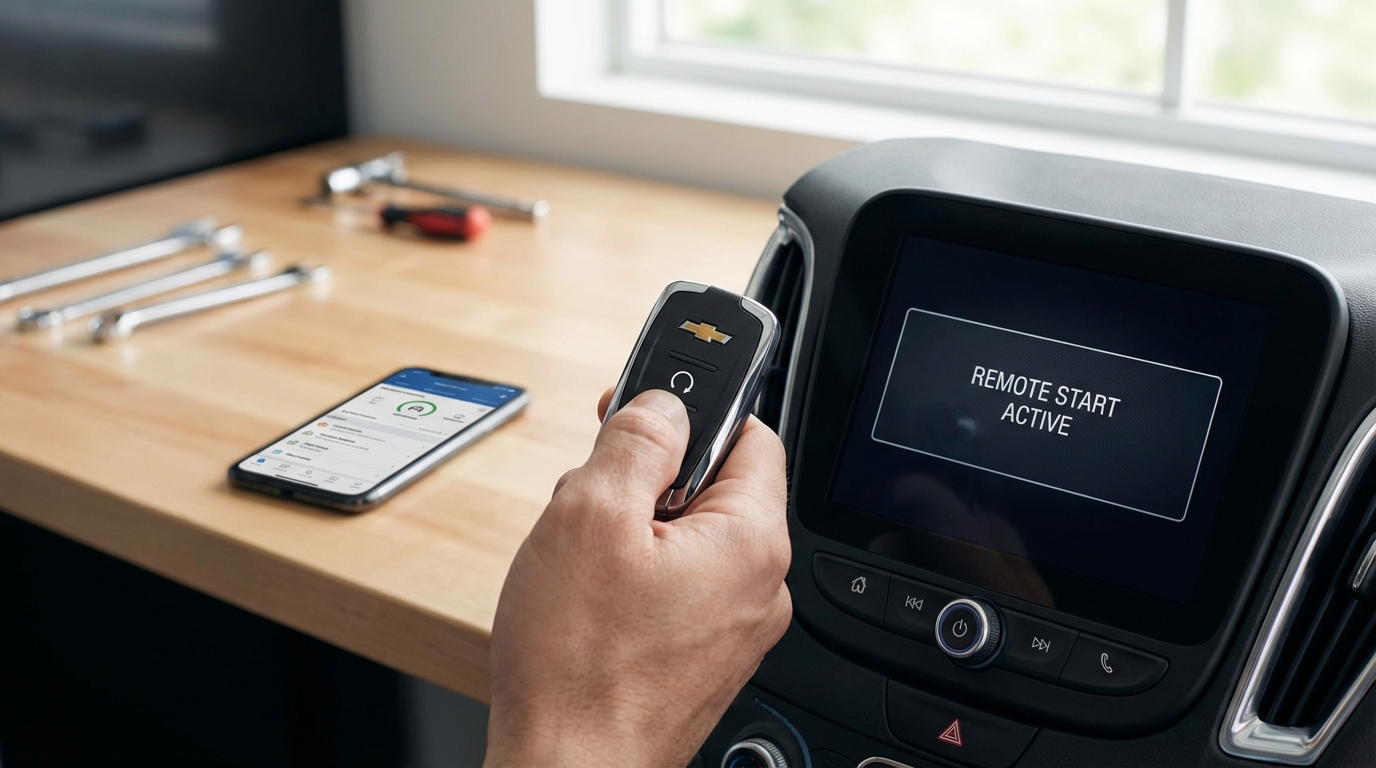
Key Takeaways: Why Your Chevy Won't Remote Start
If you're in a rush, check these things first because 90% of the time, it's one of these:
- Check Engine Light: If this light is on (even for something small), remote start is automatically disabled.
- Key Fob Battery: The battery (usually a CR2032) might be dead or too weak to send the signal.
- Hood Latch Sensor: If the car thinks the hood is open, it won't start for safety reasons.
- Two-Start Limit: You only get two remote starts (or one extension) before you have to manually turn the key.
- Coolant/Oil Issues: Low pressure or high temps will stop the engine from starting to prevent damage.
The Short Answer: Fix It Fast
If you are pressing the lock button and holding the start button but nothing happens, look at your dashboard first. Is the Check Engine Light (CEL) on? If yes, that is your problem. Chevy programs the computer to disable remote start whenever there is an active engine code. This is to stop the car from running without you watching it if there's a mechanical issue.
If there is no light on the dash, the next most common issue is the battery in your remote key fob. Swap that out for a few bucks, and you're usually good to go.
But if those two things aren't the problem, things get a little more specific. Lets dive into exactly what's going on and how you can fix it yourself without paying a dealer diagnostic fee.
1. The "Check Engine Light" Rule
This is the one that catches almost everyone off guard. You might have a very minor issue, like a loose gas cap, which triggers a Check Engine Light. Even if the car drives perfectly fine, the remote start system will shut down.
According to the Chevrolet owner's manual, the remote vehicle start function is disabled if the vehicle's malfunction indicator lamp is on. The logic here is pretty sound-if the car is "sick," the manufacturer doesn't want it idling for 10 or 20 minutes without a driver present to notice if it starts overheating or making weird noises.
How to Fix It:
You need to scan the car to see what the code is. You dont have to buy a scanner if you don't want to. Most auto parts stores (like AutoZone or O'Reilly) will come out to the parking lot and scan your car for free. Once you fix the issue (tighten the gas cap, replace an O2 sensor, etc.) and clear the code, your remote start will work again immediately.
2. The Hood Latch Sensor (The Silent Killer)
This is super common on the Silverado, Tahoe, and Suburban. There is a safety switch in the latch under your hood. Its job is to tell the car, "Hey, the hood is closed, it's safe to start the engine."
If that sensor gets dirty, corroded, or just breaks, the car thinks the hood is popped open. Obviously, Chevy doesn't want the engine to remote start if someone might have their hands inside working on the belts. So, if that sensor fails, the remote start fails.
How to Test It:
Look at your dashboard (Driver Information Center). Does it say "Hood Open" even when it's closed? If so, that's your problem. Sometimes it won't show a message, though. You can try cleaning the latch mechanism with some degreaser and WD-40 to see if the switch is just stuck.
3. Your Key Fob Battery is Weak
It sounds obvious, but a lot of people overlook it because the buttons still unlock the doors. Unlocking the doors requires a lot less signal strength than the remote start sequence. The remote start signal is more complex and requires a strong, sustained burst of power.
If you have to stand really close to the car to make it work, or if it works sometimes but not others, its definitely the battery.
How to Replace It:
- Look for a small button on the side of the fob to pull out the metal emergency key.
- Use a flathead screwdriver (or the key itself) to gently pry the plastic case apart.
- Pop out the old battery. It is almost always a CR2032 battery. You can buy these at any grocery store.
- Put the new one in (make sure the positive + side is facing the right way) and snap the case back together.
4. The "Two Starts" Limit
Did you know there is a limit on how many times you can remote start the car? This isn't a malfunction; it is a feature.
Chevy allows you to perform two remote start cycles. Each cycle usually lasts 10 or 15 minutes (depending on your model year). If you remote start it once, let it time out, and then remote start it again... that's it. You cannot do it a third time.
To reset this counter, you have to physically get in the car, insert the key (or push the start button with the fob inside), and turn the ignition to ON/RUN. This tells the car, "I am here, I am safe." Once you do that cycle, the remote start counter resets.
5. Hazard Lights are On
This is a weird one, but I've seen it happen. If you left your hazard flashers on, the remote start system is disabled. The computer assumes that if the hazards are on, the car is in a distress situation or broken down, so it refuses to turn the engine on remotely.
Just double-check that the red triangle button inside the car isn't pressed.
6. Coolant and Oil Pressure Safety
The car's computer (ECU) monitors the vitals constantly. If your oil pressure is reading dangerously low, or if the coolant temperature is way too high, the system will abort the remote start. This is a self-preservation tactic.
Usually, if this is the cause, the car might attempt to crank for a split second and then die immediately, or the lights will flash, and nothing will happen. You should check your oil dipstick and coolant reservoir just to be safe. If those levels are low, you have bigger problems than just a cold car in the morning.
7. The Car Isn't in "Park"
This mostly applies to older models with mechanical shifters that might get a little loose over time. The vehicle must be in PARK to start. If the shifter cable is stretched and the car thinks it is in Reverse or Neutral, it will not crank.
Try this: Push the shifter firmly into Park, maybe even give it a little jiggle, and try the remote start again. If it works, you know your neutral safety switch or shifter linkage is acting up.
8. Key Fob De-Programming
Sometimes, electronics just glitch out. It happens. Your key fob might have lost its pairing with the vehicle. This is less common on newer cars but can happen if the car battery died recently or if you changed the fob battery and took too long to put the new one in.
If the lock/unlock buttons don't work either, the fob is likely de-programmed. You might need to check your owner's manual for the "relearning" procedure, which often involves putting the key in the cup holder slot or the ignition in a specific sequence. If that sounds too complicated, a locksmith can reprogram it cheaper than the dealership.
9. Subscription Issues (MyChevrolet App)
Are you trying to start the car with your phone? The MyChevrolet app is cool, but it isn't always free. For a long time, Chevy offered the "Key Fob" pass for free for 5 years, but on newer models (2018 and up, generally), they started moving features behind the "Remote Access" paid plan.
If your app is greyed out or says "Upgrade to use this feature," your trial probably expired. Also, the app relies on the car having a cellular signal (OnStar). If your car is parked deep in a concrete parking garage, it might not get the signal from the satellite or cell tower to start.
Troubleshooting Checklist: Do This in Order
Don't just guess. Follow this flow to save time.
- Visual Check: Walk around the car. Is the hood fully closed? Are the doors shut?
- Inside Check: Turn the car on manually. Look for the Check Engine Light. If it's on, go get the codes read.
- Battery Check: Does the fob unlock the doors from 50 feet away? If no, change the CR2032 battery.
- Reset: Start the car manually, drive it around the block, and turn it off. This resets the "Two Start" counter and ensures the battery voltage is good.
- Settings Menu: On your infotainment screen (the radio touch screen), go to Settings > Vehicle > Remote Lock, Unlock, Start. Make sure "Remote Start" is actually toggled to "On." Sometimes a battery disconnect can revert this to "Off."
Advanced: Aftermarket Starters
If you bought your Chevy used, it might have an aftermarket remote start system installed (like Viper or Compustar). These are different than the factory ones.
Often, these have a separate "Valet Mode" switch hidden under the dashboard. If you accidentally kicked it or toggled it, the remote start disables so a valet driver doesn't accidentally start the car in a garage. Look for a small toggle switch near your shins on the driver's side or consult the manual for the aftermarket brand logo on your key fob.
Frequently Asked Questions
Does a dead car battery affect remote start settings?
Yes. If your car battery died recently or was disconnected, the computer settings might have reset. You often need to go into the vehicle settings menu on the dashboard screen and re-enable "Remote Vehicle Start." Also, after a battery disconnect, you must start the car with the key once to initialize the system.
Can I remote start with the spare key?
Absolutely. If your main key isn't working, try the spare. If the spare works, you know the issue is physically with your main key fob (broken button or dead battery) and not the car itself.
Why do my lights flash but the car won't start?
This is the car rejecting your request. It received the signal (that's why the lights flashed), but a safety parameter blocked the start. This points directly to a Check Engine Light, a Hood Ajar sensor, or low oil/coolant pressure.
Is there a fuse for remote start?
Sort of. There isn't usually one single fuse labeled "Remote Start." However, the system relies on the Body Control Module (BCM). Checking fuses related to the BCM or keyless entry can sometimes help, but usually, if a fuse is blown, other things (like door locks or radio) wont work either.
How long will the car run on remote start?
Most Chevys will run for 10 or 15 minutes. You can perform an "extension" by doing the remote start sequence again while it is already running, adding another 10-15 minutes to the timer. After that total time is up, the engine shuts off to save gas.
Will remote start work if I have a flat tire?
Usually, yes. However, newer Chevys with advanced Tire Pressure Monitoring Systems (TPMS) might inhibit start if the pressure is critically low, though this is less common than the Check Engine Light issue.
Hopefully, this helps you get warmed up (or cooled down) again. It's super frustrating when technology fails, but with Chevy's, its usually just a battery or a sensor trying to keep you safe!